
Juneteenth, today, June 19, 2026. I woke up this morning, and this was on my mind, big time. So, I spent most of this day luxuriating in wonders.
The 6th Annual Watts Towers Juneteenth Celebration won’t be at Watts Towers this year. The Towers and the Towers Arts Center are closed and will be closed for the near future while restoration takes place – the first significant restoration of Simon Rodia’s towering sculptures in Watts, Los Angeles, California. Built from 1921 to 1955 by one man, Simon Rodia. If you happen to be in LA, the celebrations in Watts will be on Saturday the 20th near the Towers.
You can read more about the Towers in many places. https://blackpast.org/african-american-history/watts-towers-1921/ Click here to link to a history of the Watts Summer Festivals.
The Towers were built in a racially mixed area of Los Angeles on private property by an Italian immigrant named Simon (Sabato) Rodia. Blacks, Latinos, Italians. During the 105 years since Rodia started the Towers, Watts has seen large fluctuations in the racial mix of its neighborhood, but is primarily Latino now (June 19, 2026).
Watts is mostly known for the rebellion that took place there in 1965. Wikipedia’s post on the Watts Rebellion is very inadequate. For a deep dive I recommend “Learnng from the Watts Rebellion.” https://www.bostonreview.net/articles/sekou-franklin-watts-rebellion-50-years-later/
Many writers continue to use the term “riot” to describe what took place that year. However, the term “rebellion” is more accurate and it is used by civil rights activists, historians, and members of the Black community to more accurately frame the event as a deliberate uprising against systemic racism, police brutality, and extreme economic inequality. Not a riot. A rebellion.
At that time in August 1965, I was living in Torrance, California, just a 20 miles from Watts, attending at El Camino Junior College. It was a huge wake-up call for Los Angeles, and it resonated throughout the world.
1965? 100 years from Juneteenth’s founding when the Civil War was ended by the proclamation Major General Gordon Granger who ordered the final enforcement of the Emancipation Proclamation in Texas at the end of the American Civil War.
Watts Towers was completed in 1955. It survived the rebellion.
Watts Towers also survived an earlier attack ordered up in 1957 by the Los Angeles Department of Building and Safety to destroy the Towers, claiming they were unstable and unable to withstand strong winds or earthquakes. To settle whether the Towers were safe, engineers designed a stress test. A crane attached to the tallest tower exerted 10,000 pounds of sideways pressure. The structure barely budged. The crane reportedly buckled. The county never tried again.
By 1963, the towers were designated as a Los Angeles and National Historic-Cultural Monument. It currently is undergoing a complete restoration and is surrounded by fencing. (June 18, 2026)
When Simon Rodia was asked why he built the towers his answer was, simply, “I had in mind to do something big and I did it.” Simple words from an unsimple man.
It became the South Central and Watts aspirational symbol for the pursuit of fairness, equality, and justice. Not to mention, the survivalist spirit.

Why would Watts Towers be on my mind today and not go away? Because, it is deeply embedded and full of meaning. Juneteenth triggers it every year.
I was fortunate enough to be able to spend a full day in 1972 at the 6th Annual Watts Towers Art Festival and visit the Towers. At the Towers, I was even more fortunate to capture some of what I feel is the deeper essence and magic of the creator and his creation. More on that in a moment.
Many years later (2012) I stumbled upon an interview of the artist Alison Saar, entitled: “Q&A with Alison Saar about her Connection to Watts Towers,” posted at Los Angeles County Museum of Art’s Un_Framed Magazine For me, the article was mind-bending.
The interviewer wrote about how Saar came from a family immersed in art: The family’s connection with the Towers began with her maternal great-grandmother, a resident of Watts, and continued with her mother, who saw Simon Rodia’s work in progress, before being passed along to Alison and even to Alison’s children.
Lucas Casso: Could you tell me a little about your first memories of the Watts Towers?
Alison Saar: Well, actually, one of my first memories of the Towers is one of the first memories I have. I think I was three years old and my mother took myself and my sister [artist Lesley Saar], who must have been five or six, to the Towers.
We must have been under one of the main towers, and when we looked up it was like a spider web. It was really wonderful for us as kids that age because it was a kind of micro-world where we could get really up close to things.
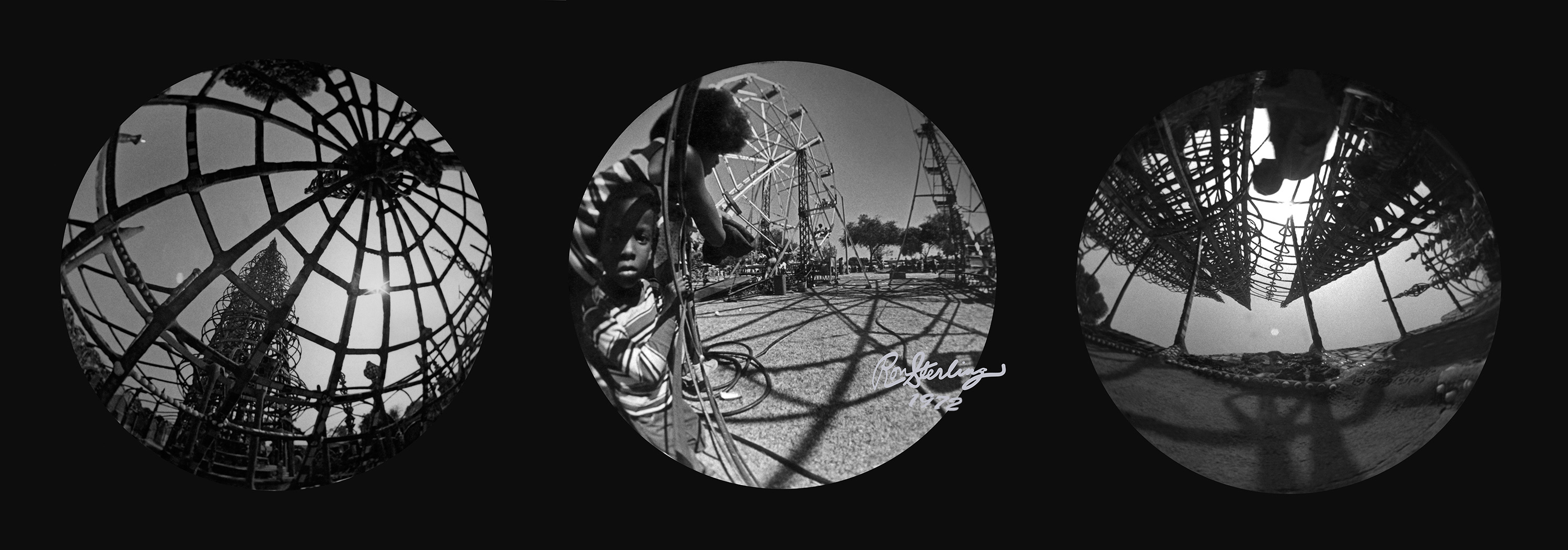
The view Saar described of looking up at the Towers through a spider web was exactly the visual magic I had captured in 1972 with a fisheye lens from below the “spider web.” Exactly the same visual impact and appreciation, embedded deeply.
So. Magic? What are the chances that a photograph of the “Towers Escaping the Web” would be discovered to be a shared visual deep experience with someone you never met who discloses the power of that same visual delight in an interview four decades later ? Chance?
I took the photographs in August 1972. They were never published, but a few prints were sold in the late 70s. I moved from Los Angeles to Hawaii, to Canada, to Kansas, to Washingon State, to Hawaii, and back to Washingon State, and somehow the negatives followed me to my current home. In 2022, I discovered the Un_Framed interview in LACMA’s publication. I digitized the film images.
I searched for Alison to find a way to send her digital copies of the photographs. I found a way to do that. I emailed the files to her.
We talked about the Towers, that particular “spider web” scenario, and how we had both interpreted it as just that, the Towers symbolizing the escape from the spider web of economic, educational, justice and peer pressure traps, so more intense in the Watts neighborhood than just about anywhere else. We agreed that there was no evidence that Rodia intended such a meaning.
Additionally, we discussed how I felt that Rodia had channeled so many things that he could not verbalize. One of the symbols found in his work is seen in how the connecting rods between two of the tall towers formed the shapes of an “ankh.”
The Ankh is a symbol that is known as “breath of life,” the key of the Nile or crux ansata (Latin meaning “cross with a handle”). It is an ancient Egyptian hieroglyphic character that meant “life.” It is often interpreted to mean eternal life.
The photographs below are a set of three fisheye lens photographs that I feel are the most symbolic of what I saw and felt that day in Watts: “a monument to the spirit of aspirations and hope, and to individuals who pursue their dreams and rise above their circumstances.” Of course, that is no easy task. And, I am sure you could ask just about anyone in Watts just how hard that can be.
When Simon Rodia was asked why he built the towers, his answer was, simply, “I had in mind to do something big and I did it.”
Rodia was uncanny, smart, and very political with a constant smile and unrelenting work ethic. The neighbors were amazed. He finally stopped working and moved to live with relatives after a fall and an injury in 1954 and 1955.
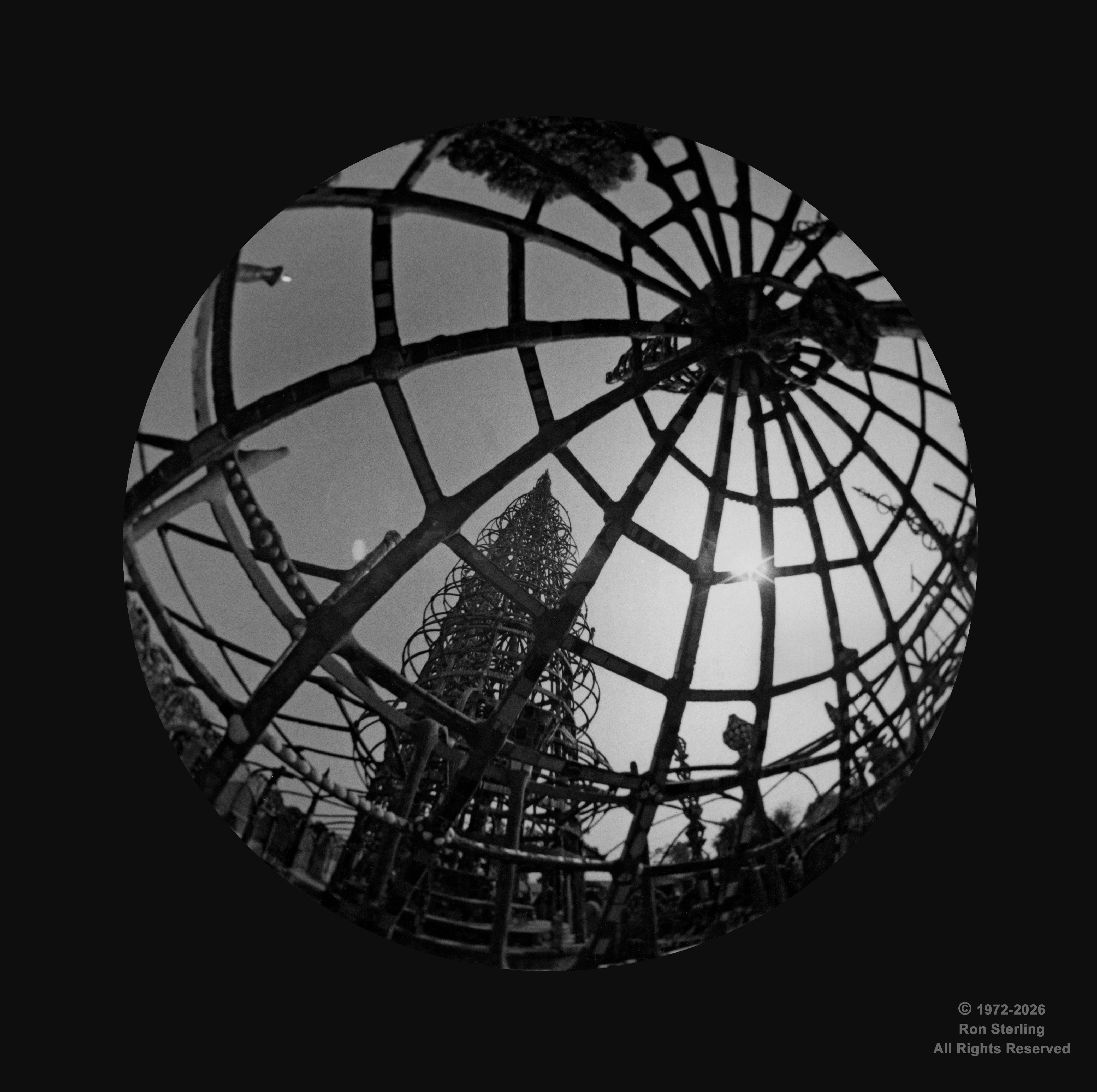
“Aspirations” by Ron Sterling, 1972.
“Transcending the web of discrimination and disrespect and
the consequences of legacies of slavery and servitude.”
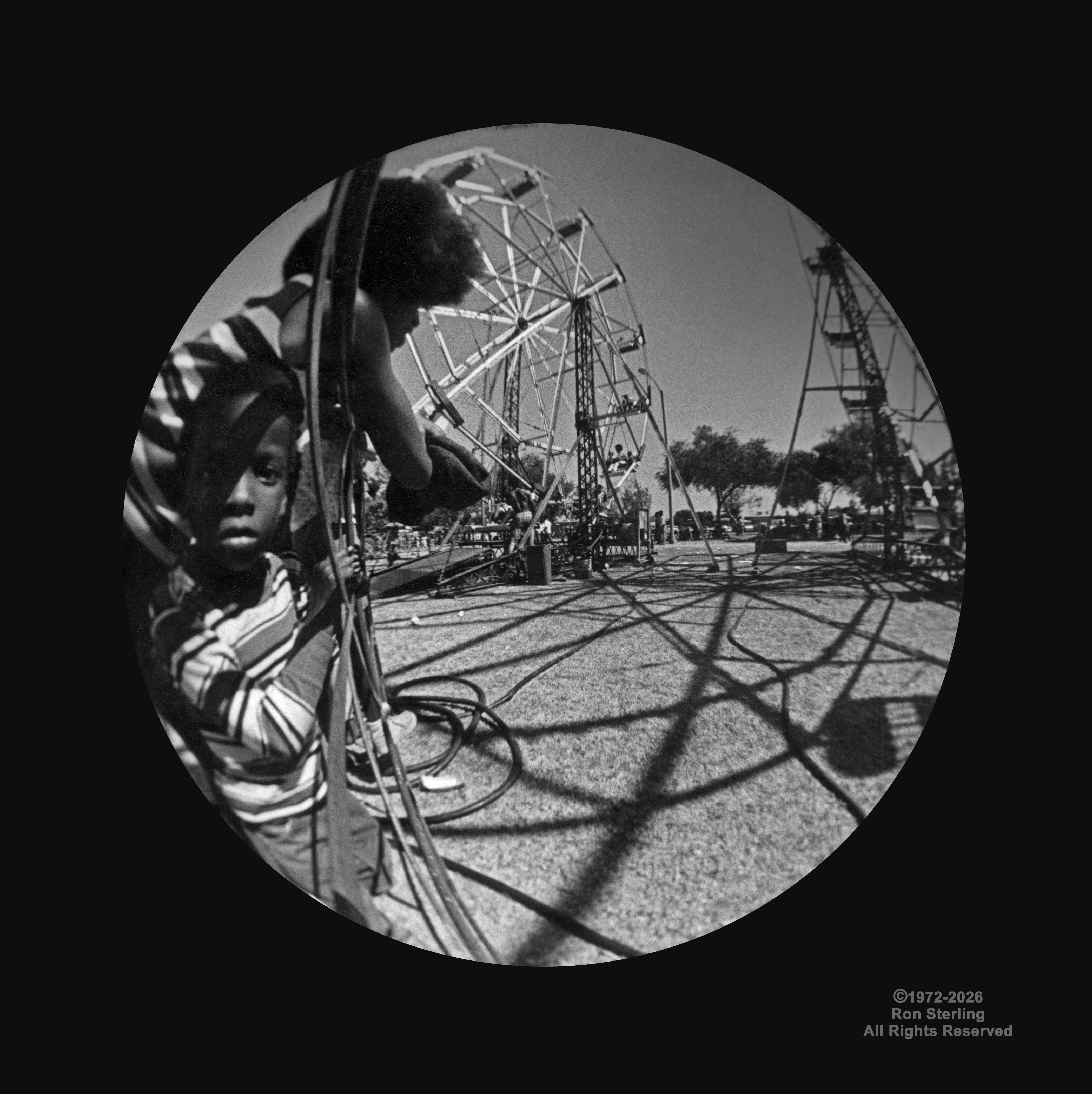
“Ascension” by Ron Sterling, 1972.
These Ferris wheels were situated close to Watts Towers.
They gave me the opportunity to compare the structures
and the shadows they cast. They all shared a common symbolism
of rising above the expectations or predictions of others. Taking flight...
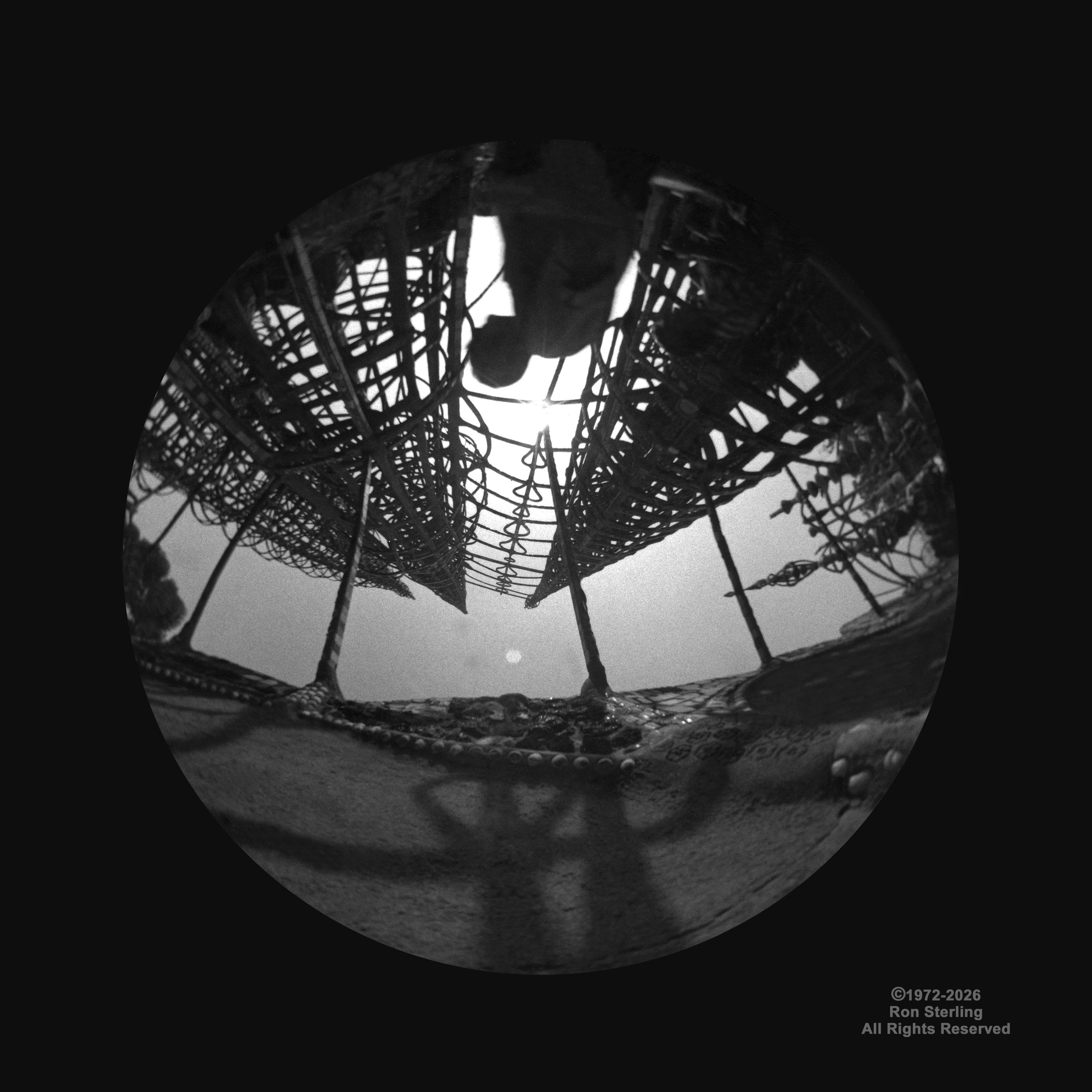
“The Ankh Within” by Ron Sterling, 1972.
“I am sure Simon Rodia had no idea that the support
and connecting rods between two of the tall towers
were formed in the shape of an “ankh.”
This has been the kind of found and shared connection that keeps me coming back for more. Right on! Juneteenth!
Postscript
I dedicated my entire day to the contemplation of what Juneteenth means to me. That included rewatching two of my abolute favorite documentaries.
"Wattstax” – A solidly soulful movie narrated by Richard Pryor. A documentary of the incredible August 1972 LA Coliseum concert sometimes known as the “Blackstock.” Isaac Hayes in the day, Right On! Amazon Link is here:
“Summer of Soul (...Or, When the Revolution Could Not Be Televised)” is the acclaimed 2021 documentary directed by Ahmir “Questlove” Thompson. It documents the historic 1969 Harlem Cultural Festival. It was called the “Black Woodstock” since it took place the same year as Woodstock. Questlove is the current drummer/lead of Roots, Jimmy Fallon’s “The Tonight Show” band.